Beginners
start here |
 Exploding
the Myths - What your broker doesn't
know or won't tell you, Exploding
the Myths - What your broker doesn't
know or won't tell you,
Frank Watkins
A great book that addresses some of the
myths that are peddled by people in the
finance industry. The most used myth is
"It is time in the market that is
important, not timing".
Frank really blows this myth apart, and
explains that "it is possible to
time the market". And I have
to add that many chartists and technical
analysts would say the same - including
yours truly.
Frank goes on to explode some other
famous myths, and provides some really
good information.
This book is a great read to help give
all of us confidence that the art of
charting does have a lot of merit.
|
 Secrets
for Profiting in Bull and Bear Markets, Secrets
for Profiting in Bull and Bear Markets,
Stan Weinstein
This is an all-time classic, published in
1988, and is still recommended reading for
people starting out with charting.
Stan's most popular concepts espoused in
this book are to do with using a 30-week
Simple Moving Average on a weekly chart -
of either a market index, or a stock. He
also discusses the concept of Stage
Analysis. [See a practical application
here, and more information about
Stan's strategies (in the left hand
column).]
Chapter 8 is great reading, "Indicators
for spotting bull and bear markets".
[See one of Robert's Presentations on Bear
Markets for more details.]
|
 Top Stocks,
Martin Roth
Martin publishes his updated copy of this
book in about October each year, for the
coming year.
This book is great at explaining some very
useful fundamental analysis criteria for
selecting quality stocks for your
watchlist. It goes on to list about
100 stocks which are essentially blue chip
stocks in the Australian market. For
anyone who is looking for a list of
quality companies in which to invest, or
trade, this book is a great start.
However, there is no regard for the
prevailing share price. So anyone who
purchases stocks that are listed in this
book will need to be buying for the long
term or for dividends, or because the
chart shows an optimum time to buy. (See Robert's views about
buy-and-hold investing.)
This study of fundamental analysis is
somewhat like the first stage of Robert's
2-stage Funda-Technical Analysis,
but taken to the next level of detail.
|
 Trend Trading,
Daryl Guppy
Daryl's classic text on trading trends is
just one of his many books, and is an
excellent one for the budding technical
analyst.
This book goes into detail discussing
Guppy's Multiple Moving Average
indicator (the GMMA), as well as his
CountBack Line (CBL) technique for entry
and exit, plus many more topics.
It includes a running case study with
in-built self-tests to test your
developing knowledge as you work through
the book.
|
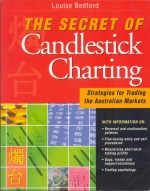 The Secret of
Candlestick Charting, Louise
Bedford
The Secret of
Candlestick Charting, Louise
Bedford
Louise Bedford has authored a number
of books over the years.
This one is a great introduction to the
mysteries of candlesticks.
Some comprehensive information about
candlesticks included in the Toolbox here.
|
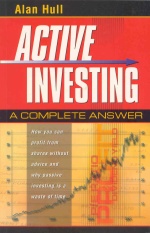 Active Investing,
Alan Hull
Alan Hull is an old hand at investing in
the share market, and runs a newsletter
service based on some of his trading and
investing strategies.
This book explains how to profit from
shares without advice and why passive
investing is a waste of time. It
explains a couple of key concepts
including the ROAR chart
indicator (Rate of Annual Return),
and Alan's own Range+ chart
indicator. (Both of these are included in
the BullCharts
charting software.)
|
|
Intermediate
information |
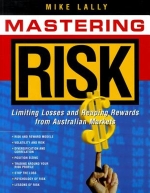 Mastering
Risk, 2002, Mike Lally Mastering
Risk, 2002, Mike Lally
This book tends to ramble on a little
bit about a whole lot of things related
to trading, and includes some good
material on risk management, including
position size considerations and the
infamous Two Percent Rule.
A highly recommended reading in a field
where little is available on investing
and trading risk management.
|
 Unholy
Grails - A New Road to Wealth;
2012, Nick Radge Unholy
Grails - A New Road to Wealth;
2012, Nick Radge
This book is highly recommended for
those who know something about technical
analysis, and who are looking for a
strategy.
Nick firstly explains some of the basic
ideas about momentum
investing, strategies (and the
importance of clearly defining your
strategy), and portfolio construction.
He also explains some possible
strategies, and their possible pitfalls.
The strategies mentioned include: New
Yearly Highs; 100-day High; TrendPilot;
Golden Cross; Moving Average Channel;
TechTrader, Flipper; and the Bollinger
Band Breakout.
|
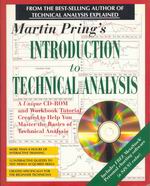 Introduction
to
Technical Analysis, Martin Pring;
1998 Introduction
to
Technical Analysis, Martin Pring;
1998
This is a great book which provides a good
introduction to the topic of technical
analysis. Includes: chart types, market
cycle model, support/resistance,
indicators and patterns.
|
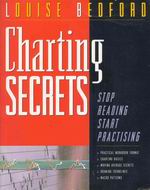 Charting
Secrets, Louise Bedford
Charting
Secrets, Louise Bedford
Louise believes there are a lot of secrets
hiding in the charts.
In this workbook she offers to explain the
secrets of: basic charts, lines, volume,
moving average, and chart and candle
patterns.
|
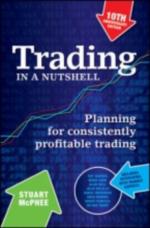 Trading
in a Nutshell, Trading
in a Nutshell,
Stuart McPhee
Trading in a Nutshell, 3rd Edition by
Stuart McPhee provides the reader even
more trading tips than the original of
this book published in 2001 and the 2nd
Edition published in 2005. This new
edition includes more information about
preparing your mind for the mental rigours
of trading as well as more guidance on how
to develop your own trading plan that you
will be able to implement with confidence.
|
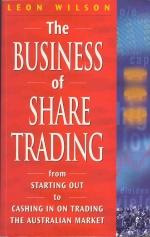 The
Business of Share Trading,
The
Business of Share Trading,
Leon Wilson
This is a great book to start looking at
some of the detail of technical analysis
indicators and strategies.
In 614 pages, Leon talks about Primary
Analysis (no indicators) and Secondary
Analysis (using indicators), plus a whole
lot more including trading and strategies.
Leon also has a couple of other books.
|
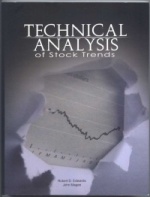 Technical
Analysis of Stock Trends, Robert
D. Edwards and John Magee
Technical
Analysis of Stock Trends, Robert
D. Edwards and John Magee
This is accepted as the bible of technical
analysis. 484 pages, first published in
1948, and republished and reprinted a
number of times over the years. Contains
lots of great information about TA.
Affectionately known as "Edwards and
Magee".
|
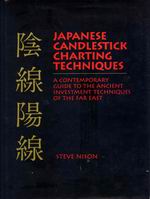 Japanese
Candlestick Charting Techniques, Japanese
Candlestick Charting Techniques,
Steve Nison
Steve Nison is often regarded as the
person who picked up the centuries-old
Japanese studies of candlestick charting
and introduced it to western society.
This big book is basically an encyclopedia
of candlestick charting patterns, and its
application in conjunction with a number
of classical technical analysis concepts
and indicators such as support and
resistance, moving average, RSI,
Stochastic, Momentum and OBV.
|
The book covers shown here are
the scanned cover images of books that
Robert has purchased, or borrowed - with credit
and acknowledgments to the respective copyright
owners.
|
Advanced
and
specialist topics |
 Trade
Your Way to Financial Freedom, Trade
Your Way to Financial Freedom,
Van K Tharp
Van Tharp is very highly regarded in
trading circles.
Some of the gem topics in this book
include: Position Size (methods and
optimising, including the Percent Risk
Model and the Two Percent Rule), Stop Loss
methods (including ATR-based), and trading
system metrics (eg. expectancy).
This book covers a lot of trading topics
including: judgmental biases (in chapter
2), developing a trading system,
expectancy, risk and money management,
trade setups, market timing, entry
signals, taking profits, opportunity cost
and position sizing.
|
|
 How I Made
$2,000,000 in the Stock Market,
Nicolas Darvas
How I Made
$2,000,000 in the Stock Market,
Nicolas Darvas
This well-known best-seller was published
in 1960 by Lyle Stuart Inc (Kensington
Publishing Corp), and re-printed several
times.
It contains information that most brokers
would not want you to know about. It
includes graphic details of the
methodology and approach that Nicolas
Darvas followed over just a couple of
years to make two million dollars in the
market - all legit!
See some summary details about Darvas'
strategy in Brainy's eBook (PDF)
Articles (left hand column).
|
|
 Trade
with Passion and Purpose, Mark
Whistler Trade
with Passion and Purpose, Mark
Whistler
Many of the experts say that making money
in the markets is not easy, but that about
80% of the job is really down to emotions
and psychology. And without a good handle
on one's own emotions, it is likely to be
difficult.
In this book, Mark talks extensively about
many of the keys to becoming a top trader
with a good understanding of how to be in
control of our emotions, and our
psychological well-being.
|
|
 The
Secret Life of Real Estate and Banking, The
Secret Life of Real Estate and Banking,
Phillip J Anderson
Phil spent many years researching and
writing about the real estate market in
the US, covering property transactions and
cycles since 1800.
Phil took all his research and lecture
notes and published them in this book that
provides great insight into the property
cycles, and the underlying reason why
property prices move in cycles of between
17 and 21 years.
A recommended read.
See more details here.
|
|
 A
Definitive Guide to Point and Figure,
A
Definitive Guide to Point and Figure,
Jeremy du Plessis
The sub-title on this book says it all: "A
comprehensive guide to the theory and
practical use of the Point and Figure
charting method".
This is a big book that explains how
Jeremy transitioned from his training in
engineering and as an economist to become
a technical analyst, who founded Indexia
Research in 1983, and developed PC-based
software that utilises Point and Figure
charting that is very popular today.
Many technical analysts today use Point
and Figure charts to easily spot trends,
and identify potential market
turning points.
|
|
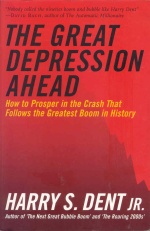 The Great
Depression Ahead, Harry S Dent jr.
The Great
Depression Ahead, Harry S Dent jr.
Harry wrote and published this text in
late 2008, in anticipation of a great
depression ahead (which at the time of
updating this web page in 2019 has still
not occurred).
Harry's studies and work over many years
has looked at the huge range of cycles
that are evident within society, and
countries, and technologies, and in fact
are everywhere.
For anyone interested in understanding
what sort of cycles are in existence, and
how they have played out and affected our
lives over the years, this text is a must.
|
|
|


